

-
You’ve decided to stop buying bags that need replacing every couple of years. Good decision. But now you’re staring at a range of leather bags – backpacks, briefcases, messenger bags, duffles – and the question isn’t whether to buy leather. It’s which leather bag, and for what.
This guide is built for men buying their first quality leather bag. It covers everything you need to know before spending your money: what leather grade actually matters, which bag format suits which lifestyle, and how to make a decision you won’t revisit in three years.
No filler. No jargon for its own sake. Just the information that changes how you shop.
Start Here: Not All Leather Is the Same
Before you think about bag style, compartments, or colour – understand one thing. The word “leather” on a product label means almost nothing on its own. It’s applied to materials that perform completely differently over time, and most of the confusion first-time buyers experience starts here.
There are four grades worth knowing:
- Full-grain leather is the top layer of the hide, left largely intact. The natural fiber structure – tight, dense, interlocked – stays in place. Nothing is sanded away. Nothing is coated over. This is the strongest version of the material, and the only grade that develops a patina over time. It’s what every bag in the IND Leather range is made from.
- Top-grain leather has been sanded or buffed to remove surface imperfections, then coated with a synthetic finish to create uniformity. Softer and more pliable than full-grain, but the natural surface has been compromised. Less durable over the long term.
- Genuine leather sounds like a quality claim. It isn’t. In the leather grading system, it’s one of the lowest usable grades – made from inner layers of the hide after the top grain has been removed, heavily processed, and coated with synthetic finishes. That coating eventually cracks and peels, which is what most people associate with cheap leather bags failing after a year or two.
- Bonded leather is the bottom of the hierarchy – scraps and fibers combined with adhesives. It deteriorates the fastest and has no place in a quality bag.
When you see a brand use the term “full-grain leather” specifically, that’s a verifiable claim. When you see “premium leather,” “high-quality leather,” or “genuine leather,” those terms carry no standardised quality meaning. The absence of specific grade language almost always reflects the absence of quality material.
Further reading: ( Why Full-Grain Leather Is the Best Choice for Men’s Bags) and ( What Is the Difference Between Full-Grain and Genuine Leather?) go deep on why this distinction changes everything about how a bag performs over time.
What Happens to Full-Grain Leather Over Time (And Why It Matters)
Here’s the thing most first-time buyers don’t expect: a full-grain leather bag doesn’t peak on the day you buy it. It gets better.
The process is called developing a patina – a gradual transformation of the leather’s surface that happens through real use. Sunlight deepens the tone. Natural oils from your hands absorb into the grain wherever you make consistent contact. Friction smooths sharper textures at edges and corners. Small marks blend into the overall surface rather than sitting on top as visible scratches.
Over months and years, the bag stops looking like a product and starts looking like something that belongs to you specifically – richer, more refined, more personal. The handle darkens where you grip it. The body develops a subtle sheen. No factory can replicate this. No other bag develops it the same way.
Lower-grade leather with synthetic coatings can’t do this. The coating blocks the natural aging process. Instead of developing character, it just deteriorates – cracking, peeling, looking progressively worse. That’s not leather aging. That’s a coating failing.
Understanding patina isn’t just interesting – it reframes what “value” means in a leather bag. You’re not buying something that depreciates. You’re buying something that improves.
Further reading: (What Is a Leather Patina and Why Does It Matter?)
The Four Bag Formats – and Which One Suits Your Life
Once you understand the material, the decision becomes about format. Each bag solves a different problem. The right one depends on how you actually move through your day – not how you imagine you might.
The Leather Briefcase – For Structure, Presence, and Professional Settings
A leather briefcase is the most formally positioned bag in the range. It communicates something before you say a word – organisation, intentionality, attention to detail. In industries where those signals matter – finance, law, consulting, traditional corporate environments – a briefcase carries authority that no other format matches.
What it does well:
- Keeps documents flat and accessible in defined compartments
- Pairs cleanly with tailoring – the silhouette is narrow and structured
- Signals professionalism in high-stakes client or boardroom settings
- Holds its shape under load without collapsing
Where it creates friction:
- Single-shoulder or hand carry means asymmetric load over long commutes
- Less practical if your day involves significant movement between multiple locations
- Can feel like something you’re managing rather than something helping you on dynamic days
Choose a briefcase if: Your workplace is formally structured. You carry mostly documents and a laptop. You spend most of your day in one location – meetings, a desk, a client’s office. The visual authority of a briefcase has specific value in your professional context.
Explore the IND Leather Briefcase Collection →
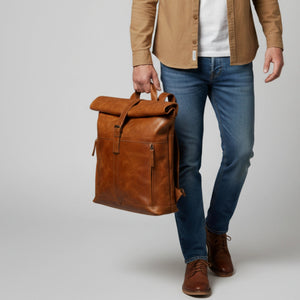
The Leather Backpack – For Movement, Comfort, and Modern Work
A leather backpack solves a different problem entirely. It’s designed for mobility – for the man whose day involves a commute, multiple locations, and sustained carry over hours rather than minutes.
Weight distributed across both shoulders changes the carrying experience fundamentally. You can load a backpack more heavily than a briefcase and feel it less. Over a long commute or a day of moving between locations, that difference is significant. Your posture isn’t pulled to one side. You arrive places without feeling like you’ve been carrying something.
The hands-free format matters more than it seems in the abstract. Navigating a busy transit system, managing a boarding pass through security, handling a coffee while unlocking a door – having both hands available reduces friction in small ways that compound across a full day.
What it does well:
- Distributes weight evenly – essential for long commutes and high-movement days
- Hands-free carry across transit, travel, and city navigation
- Versatile enough to carry from work to a weekend trip without switching bags
- Full-grain leather exterior makes it work in professional settings that nylon backpacks can’t
Where it creates friction:
- In very formal environments – traditional law firms, high-level client meetings – a briefcase may carry more visual authority
- Main compartment access requires swinging the bag forward or removing it in some situations
Choose a backpack if: You commute daily, especially by foot or public transit. You carry tech, chargers, and daily essentials alongside work items. Your workplace culture is modern enough that a leather backpack reads as professional rather than casual – which, in most contemporary offices, it does.
Explore the IND Leather Backpack Collection →
Further reading: (Leather Backpack vs Briefcase: Which Is Better for Work?) breaks down this comparison in detail, including how workplace norms have shifted and when each format earns its place.
The Leather Messenger Bag – For Fast Access and Flexible Contexts
The messenger bag occupies a position between the formality of a briefcase and the utility of a backpack. That middle position – which can seem like a compromise – is actually a flexibility advantage.
The core advantage of a messenger bag is speed of access. It sits across the body and swings forward with a single motion. The main compartment is immediately accessible without removing anything, setting anything down, or repositioning. In routines involving constant movement – commuting through a city, moving between meetings, running errands – that speed matters practically across a full day.
What it does well:
- Fastest access of any bag format – swing forward, open, retrieve, keep moving
- Cross-body carry keeps both hands free throughout the day
- Sits between formal and casual aesthetically – works across a wider range of contexts than a briefcase or nylon backpack
- Clean silhouette that doesn’t add visual bulk to the outfit
Where it creates friction:
- Single-shoulder cross-body carry creates fatigue under heavy loads over long distances
- Less suitable for very formal environments where a briefcase carries specific visual authority
- Better suited to light-to-moderate daily loads than heavy tech setups or substantial gear
Choose a messenger bag if: You carry a light-to-moderate load daily – a tablet or smaller laptop, documents, personal essentials. You move frequently and value fast access over maximum carry capacity. Your routine involves transit, commuting, or navigating a city where cross-body carry makes more practical sense.
Explore the IND Leather Messenger Bag Collection →
Further reading: (Are Leather Messenger Bags Still in Style?) covers why the format has remained consistently relevant and what design characteristics separate the ones worth buying from those that date quickly.
The Leather Duffle Bag – For Travel, Weekends, and Heavy Carry
A leather duffle is built for movement across multiple days. It’s the format that handles weekend trips, gym carry, and travel without becoming an obstacle at any point in the journey.
The practical advantage of a duffle over a hard-shell carry-on or structured suitcase is flexibility. It adjusts to the space available – in an overhead bin, a car boot, a hotel luggage rack – rather than competing with it. At the same time, a well-constructed leather duffle maintains enough structure to protect its contents and hold its shape when set down. That balance – flexible enough to adapt, structured enough to function – is what makes the format genuinely practical.
For travel specifically: a full-grain leather duffle can comfortably carry between 30 and 50 pounds depending on construction. The dense natural fiber structure of the top grain distributes load rather than concentrating it at stress points. Well-built handles and reinforced base structure handle that weight consistently across hundreds of loading and unloading cycles.
What it does well:
- Adapts to tight spaces – overhead compartments, car trunks, luggage racks
- Handles heavy loads without structural compromise when built from full-grain leather
- Works as a travel carry-on, gym bag, and weekend bag without switching
- Develops patina with every trip – looks more refined the more it travels
Where it creates friction:
- Not a daily carry option – built for multi-day movement, not desk-to-meeting transitions
- Doesn’t replace a large rolling suitcase for extended trips requiring a full wardrobe
Choose a duffle if: You travel two to four days at a time and prefer to carry on rather than check. You want one bag that consolidates your travel, gym, and weekend carry. You need something that holds up to real travel conditions – overhead compartments, airport floors, varying handling – without deteriorating.
Explore the IND Leather Duffle Bag Collection →
Further reading: ( What Makes a Leather Duffle Bag Ideal for Weekend Travel?) and (How Much Weight Can a Leather Duffle Bag Carry?) cover the travel use case and load-bearing construction in detail.
How to Match the Bag to the Occasion
Still deciding? Map your most common use cases against the format that serves them best.
Occasion Best Format Why Daily office commute (public transit) Backpack Weight distribution, hands-free, comfort over distance Client meetings, formal presentations Briefcase Visual authority, clean silhouette alongside tailoring City commuting with frequent stops Messenger Fast access, cross-body carry, versatile across contexts Weekend trips, carry-on travel Duffle Flexible sizing, adapts to transit environments International travel (1 week or less) Backpack Carry-on compatible, transitions from airport to destination use High-movement days across multiple locations Backpack or Messenger Hands-free carry, fast access, sustained comfort Gym + work in one bag Duffle Capacity for both without over-engineering If your week varies significantly – formal days alongside high-movement ones – many men find they naturally reach for different bags depending on what the day requires. A briefcase for client-facing or formal days. A backpack for commute-heavy days. The IND Leather range is built so that each format works to a consistent material and construction standard, meaning you’re not trading quality when you switch formats.
What to Look for When Buying: The Non-Negotiables
Whether you’re buying from IND Leather or evaluating any leather bag online, these are the things that separate a genuinely well-made bag from one optimized for its product photos.
- Specific material language. “Full-grain leather” is the term that matters. It’s a verifiable industry grade. “Premium leather,” “genuine leather,” and “high-quality leather” are marketing language with no standardized meaning.
- Reinforced stress points. Where handles attach to the body, where the base meets the sides, where zippers are sewn in – these are the points that fail first on poorly built bags. A brand worth buying from talks about reinforcement here specifically, not just in general durability terms.
- Hardware quality. Zippers, buckles, rings, and attachment hardware are used hundreds of times over the life of a bag. Solid metal hardware specified for durability, not appearance, is what holds up. Lightweight metal or plastic components are the first thing to show failure under daily use.
- A meaningful warranty. A genuine lifetime warranty on materials and craftsmanship means the brand expects the product to outlast the warranty’s relevance. It’s a financial commitment that only makes sense if the product genuinely doesn’t fail from craftsmanship issues. Short warranties or those with extensive exclusions protect the seller, not the buyer.
- Transparent return policy. A 30-day no-questions return policy signals confidence that the product matches what’s described. Restrictive return conditions protect a brand from customers who discover the gap between presentation and reality.
Further reading: ( How Can You Spot a High-Quality Leather Bag Online?) covers the full checklist of signals – including red flags in product descriptions, image details to examine, and how to read customer reviews for durability information rather than just satisfaction.
The Lifetime Warranty – What It Actually Means
IND Leather backs every bag with a lifetime warranty on materials and craftsmanship. It covers stitching failures at stress points, hardware malfunctions under normal use, and structural construction failures. It doesn’t cover natural aging – patina development, tone deepening, surface variation – because those aren’t defects. They’re the expected evolution of full-grain leather.
The warranty exists because the product is built to a standard that makes long-term coverage a reasonable commitment rather than a financial risk. Over 150,000 bags reached customers through retail partners before IND Leather’s direct store launched – real-world evidence of how the products perform at scale, over time, under daily use. The warranty is informed by that evidence, not in spite of it.
A lifetime warranty from a brand that means it changes the buying decision in one specific way: it removes the durability uncertainty that makes buying an unfamiliar brand online carry risk. If the bag fails because of how it was built, it gets fixed or replaced. That accountability belongs with the brand, not the buyer.
Further reading: (Why Does IND Leather Offer a Lifetime Warranty?)
The Real Cost Calculation – Why “More Expensive” Is the Wrong Frame
The most common reason first-time buyers hesitate on a full-grain leather bag is price. It costs more upfront than a nylon alternative or a “genuine leather” bag from a mid-market brand. That’s true.
What’s also true: the comparison only makes sense if both bags have the same functional lifespan. They don’t.
A nylon or genuine leather bag used daily typically lasts two to four years before structural failure – surface cracking, zipper degradation, handle loosening, shape loss – makes it impractical to continue using. A full-grain leather bag built to the right standard lasts decades under the same conditions.
A bag replaced every three years over a decade costs more – in money, in time finding a replacement, in the adjustment period with something new, in the repeated compromise of settling for something that will need replacing again – than a single well-built leather bag bought once and carried for the same period.
Cost per use, over time, is the metric that actually matters. Purchase price tells you nothing useful about value.
Further reading: (How Long Should a High-Quality Leather Bag Last?) lay out the full economic and experiential comparison across a meaningful time horizon.
Caring for Your First Leather Bag – It’s Simpler Than You Think
Full-grain leather is durable. It handles daily use without constant intervention. What it benefits from is basic, consistent care – not overdone, not ignored.
The core habits:
- Clean regularly. A soft cloth, slightly damp, wiped across the surface every week or two. That’s it for routine cleaning. Avoid detergents, alcohol-based cleaners, or household products – they strip the natural oils that keep leather supple.
- Condition every 3–6 months. A quality leather conditioner applied with a soft cloth, worked in evenly, left to absorb, then buffed off. This is the single most important maintenance step. It keeps the leather flexible and prevents surface cracking. Don’t over-condition – occasional and consistent is the right approach.
- Handle water correctly. If the bag gets wet, blot (don’t rub) with a dry cloth immediately, then air dry naturally at room temperature. No radiators, no hair dryers, no direct sunlight. Rapid heat drying pulls moisture out unevenly and causes cracking.
- Store properly. In a dust bag, in a cool dry place away from direct sunlight. Stuff lightly with tissue paper if storing for an extended period to help the bag hold its shape.
- Don’t overfill. Consistent overpacking stresses seams, zippers, and base structure. If it requires force to close, it’s too full.
The actual time commitment: a wipe-down takes two minutes. A conditioning session takes ten, and happens three or four times a year. That minimal effort is what the difference between a bag that looks great at year five and one that looks tired at year two comes down to.
Further reading: (How Do I Properly Care for a Full-Grain Leather Bag?) covers the full care process in detail, including how to handle specific stains and what storage conditions matter most.
Making the Decision
Here’s the decision simplified:
- Buy a briefcase if your professional environment is formal and presentation carries real weight in your work.
- Buy a backpack if you commute daily, move through your day across multiple locations, or want one bag that handles work and travel without switching.
- Buy a messenger bag if you carry a lighter daily load, move constantly, and want fast access to your essentials without removing the bag.
- Buy a duffle if you travel regularly for two to four days and want one bag that handles the journey, the destination, and the return trip without you thinking about it.
If you’re genuinely between formats, consider what your most common day looks like – not your best day or your most formal day, but the day you live most often. The bag that fits that day is the right starting point. The rest can follow.
Why IND Leather
IND Leather was built around one principle: make something that doesn’t need replacing.
Full-grain leather across every bag in the range – not as a premium tier, but as the baseline. Construction focused on stress point reinforcement because that’s where bags fail first. Hardware specified for thousands of use cycles, not for appearance in product photography. A lifetime warranty because the product is built to a standard that makes the commitment viable rather than risky.
A 15% discount is pre-applied at checkout across the full range – no code required. Free shipping on all orders over $99. And 24/7 support at support@indleather.com if anything needs clarification before, during, or after your order.
The first quality leather bag you buy should be the last bag you need to think about buying. That’s what IND Leather is built for.
Explore the full range:
✦New arrivals just dropped
✦Free delivery on orders above $99
✦USA delivery in 7–8 days
✦30-day hassle-free returns
✦New arrivals just dropped
✦Free delivery on orders above $99
✦USA delivery in 7–8 days
✦30-day hassle-free returns
✦New arrivals just dropped
✦Free delivery on orders above $99
✦USA delivery in 7–8 days
✦30-day hassle-free returns
-
Dakota Roll-Top Backpack
$99.99$285.990 people viewing this productONLY ITEMS LEFT -

Nomad Pro 16 Backpack
$342.99$119.99$342.990 people viewing this productONLY ITEMS LEFT -

Canyon Rugged Expedition Backpack
$89.99$256.990 people viewing this productONLY ITEMS LEFT -

McKinley Vintage Alpine Backpack
$99.99$285.690 people viewing this productONLY ITEMS LEFT
